Why Elites Don’t Control the System — They’re Controlled by It
„You could double the taxes I pay, and it’s not gonna help that nurse in Queens. I promise you.“ Those were the words of Jeff Bezos—broadcasting live from his private rocket base on Merritt Island, Florida. In the background: rockets destined for outer space. In the foreground: advice for the nurse in Queens.
And yet he has a point—he just doesn’t understand what it means for him: that it will one day cost him everything.
The Social Reality
For years, elites, industry associations, and corporations have shaped policy. That much is common knowledge. What is less understood is how far it has gone: lawmakers can barely decide freely anymore — and after a while, they stop wanting to. Those who are rewarded by lobbying groups and face no accountability from the public quickly learn whose interests are worth their time. (Drutman, 2015)
Alongside this operates what might be called structural continuity of power—private-sector networks that outlast election cycles, accumulate influence, and pursue aligned interests. They do not need to coordinate. Their goals converge structurally. Their power is not conspiratorial. It is systemic. (Hall & Deardorff, 2006; Sklair, 2002)
A single example from recent legislation illustrates what this looks like in practice. In at least 30 pieces of German federal legislation over the past five years, corporate representatives were involved not as outside consultants but in the actual drafting. In the EU’s General Data Protection Regulation, entire passages were lifted word for word from position papers by Amazon, eBay, and the US Chamber of Commerce. This is not an anomaly. It is the pattern. (Bundesrechnungshof, 2008; Otto & Adamek, 2008)
The lobbyist supplies the draft. The legislator supplies the majority. Parliament supplies the legitimacy. No law is broken. No bribe changes hands. The process is clean—only the outcome no longer belongs to the public but to those who wrote it. (Ars Technica, 2013; Wired UK, 2013)
The Public Picks Up the Tab
The tax burden falls on ordinary citizens, while elites and large corporations minimize their contributions. Companies shift operations to tax havens, move profits, fabricate expenses. The business lobby exerts massive influence over tax legislation—in its own favor. (Cobham, 2020; Tørsløv, Wier & Zucman, NBER, 2018)
In the United States, the wealthiest one percent hold over 35 percent of household wealth. In Europe, the richest one percent own more than 20 percent. The establishment dismisses criticism of this—the current arrangements suit them just fine. Bezos himself paid an effective federal tax rate of around one percent between 2006 and 2018, during which his net worth grew by an estimated 127 billion dollars. In 2007 and 2011, he paid no federal income tax at all—legally, rationally, competitively. Hundreds of other billionaires did exactly the same. (ProPublica, 2021)
The Logic of Erosion
But why does it stay this way? Anyone living in a world whose reality differs so fundamentally from that of almost everyone else will inevitably lose touch with that other reality. This is not a moral failing—it is adaptation to one’s environment, something every human being does. The difference is that the environment here is so extreme that the adaptation is extreme too. The mechanism is not hard to follow: the person who steps around a homeless man on the street, ignores him, instinctively looks away—is doing the same thing. Just at a different point on the scale. (Frederick & Loewenstein, 1999; Quoidbach et al., 2010; Diener, Lucas & Scollon, 2009)
Anyone who has established themselves professionally and financially at this level is also permanently focused on one thing: not losing their position. Habituation ensures that one’s own circumstances are systematically underestimated—personal successes become the baseline, while the successes of others stand out. This produces dissatisfaction and keeps driving people forward, even those who objectively already have everything. The fear of falling back increases the willingness to bend rules and exploit gray areas to hold one’s position. And competition generates pressure to act. Those who forgo lobbying cede political ground. Those who reject tax avoidance fall behind in the market. (Bazerman & Tenbrunsel, 2011; Miller, 1999)
The result: policy decisions increasingly favor these influential groups. This is not a German or European peculiarity. Gilens and Page demonstrated in a widely cited analysis that the preferences of the average American have virtually no bearing on public policy. What matters is what elites and organized interest groups want. Politics becomes theater—the performance of freedom for the masses. (Gilens & Page, 2014; Acemoglu & Robinson, 2012)
The public loses. The middle class loses influence. Those with lower incomes are left behind. Declining educational quality, shrinking social support, deteriorating living conditions. A classic prisoner’s dilemma — because society is the very foundation on which elite wealth rests. Social order. Legal certainty. Consumer spending power. Social infrastructure. Trust in institutions. Systematically undermining all of this means sawing off the branch you’re sitting on. (Gilens, 2005; Campos & Giovannoni, 2007; Hardin, 1968)
This is a dilemma that their own net worth could easily dissolve. But it never does. Beyond alienation, the economic system reproduces exactly the thinking that perpetuates it. Decades of immersion in structures and networks where tax optimization is normal, political influence is just another resource, and redistribution is a naive idea—this shapes the mind. Social division deepens the erosion of solidarity: empathy atrophies, status normalizes, moral detachment sets in. The mechanism does not stop at the bank balance — not even for those who believe they stand above the system. (Norris & Inglehart, 2019; Foa & Mounk, 2016)
The process compounds itself. As social problems multiply, elites lose faith in the public. Elites pursue their own interests more aggressively. The public loses faith in institutions. Democracy erodes: democratic systems are in retreat worldwide. (EIU, Democracy Index 2024)
This Is Not By Design. It Is a Mechanism.
Bezos is right: doubling his taxes won’t help the nurse in Queens—not as long as the political system systematically ignores her interests. But he identifies the symptom while concealing the cause. Because he is part of the mechanism that keeps things exactly as they are.
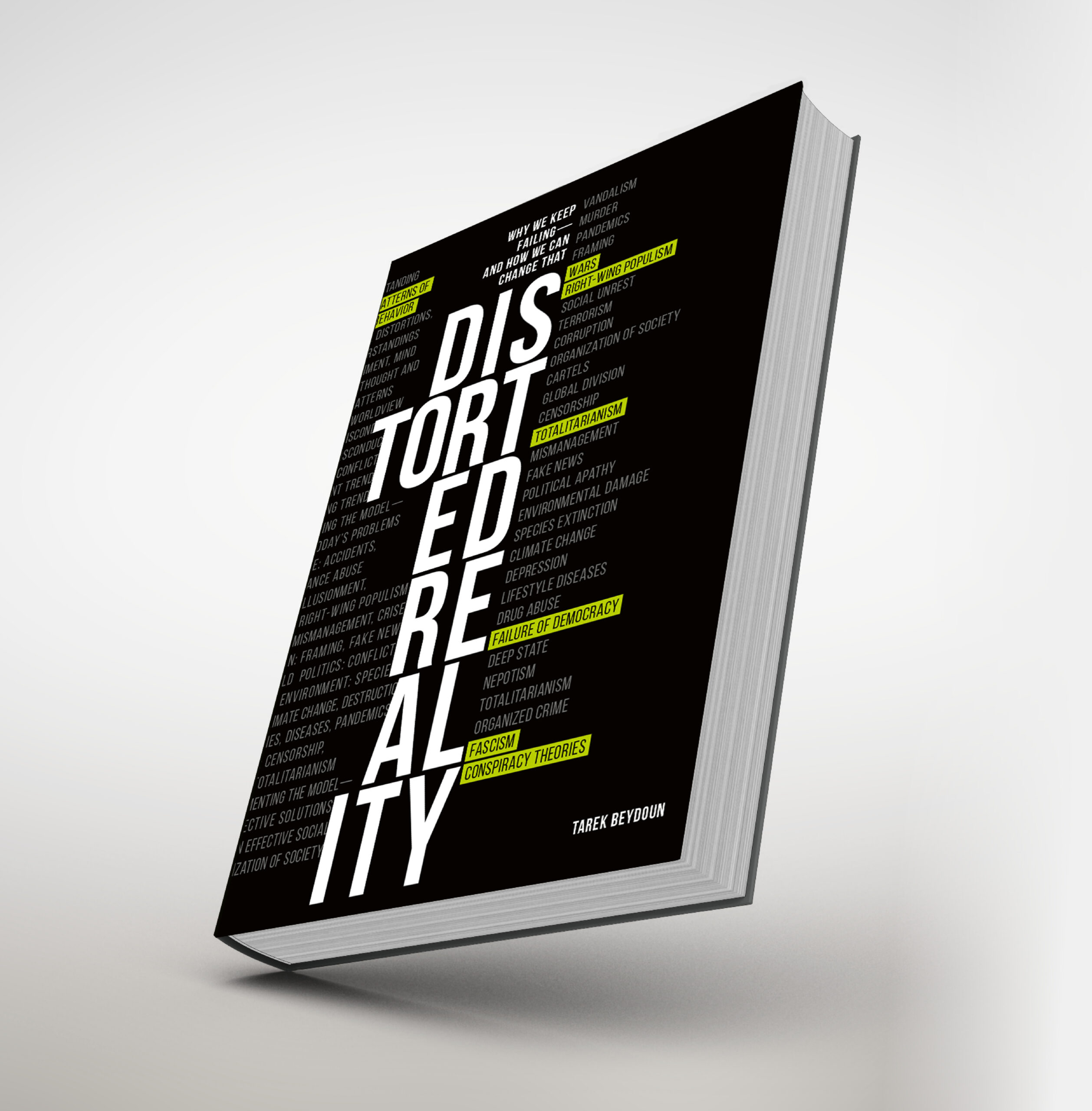
Those who want to understand the mechanisms that are destroying democracies—and what can be done about it—will find answers in
Distorted Reality -> Order here