The Dismantling of a Superpower and the Failure of Democracy
Oval Office, Washington D.C., June 4, 2026. Donald Trump falls asleep on camera—multiple times—during a live announcement about the coal industry. Three months earlier, Doral, Florida: Trump declares the Iran war over, then not over, then both. He claims Iran is in possession of American Tomahawk missiles. He contradicts his own Secretary of Defense and Secretary of State. (Snopes, 06/04/2026; Politifact, 03/09/2026)
Washington, D.C., July 11, 2024. Joe Biden introduces his Vice President Kamala Harris as „Vice President Trump.“ On live camera, the Secretary of State, the Secretary of Defense, and the National Security Advisor are seen closing their eyes and looking down. Minutes earlier, Biden had introduced Ukrainian President Zelensky as „President Putin.“ Two years before that, Biden scanned the audience for Congresswoman Jackie Walorski—“Where’s Jackie?“—who had died two months earlier. He had signed the condolence letter. (C-SPAN / The Guardian, 07/11/2024; CNN / Washington Post, 09/28/2022)
The most powerful men in the world—erratic, incompetent, confused. Not in spite of the system. Because of it. Meaning: the economic and political order—and the incentives it creates for socio-political, democratic, economic, and financial decisions—that rewards those who exploit it and punishes those who try to fix it.
Why This Is Not an Anomaly
What we are witnessing is the predictable outcome of decades of degenerative processes. Those who understand these processes are not surprised — they are simply staggered by how far things have already gone.
Political dysfunction follows recognizable patterns.
Ignorance as a default state. Most citizens develop an idealized, one-dimensional image of democracy early on. The permanent influence of lobbying groups on the legislative process goes entirely unacknowledged. Voting decisions are not based on competence and integrity — they are based on personal likability and ideological alignment. Those who argue with nuance lose. Those who polarize win. Polarization is rewarded. (Downs, An Economic Theory of Democracy, 1957; Hetherington & Weiler, Authoritarianism and Polarization in American Politics, 2009)
The bar keeps falling. Moderate politics appears adequate—not because it is, but because the bar itself has dropped. The presence of extreme parties makes moderate parties look responsible by comparison. This bolsters trust in mainstream politics and weakens the pressure to hold it accountable. (Norris & Inglehart, Cultural Backlash, 2019)
Discourse failure as the new normal. Political discourse no longer produces solutions. It produces validation. Filter bubbles, motivated skepticism, comprehension bubbles—the same evidence is evaluated differently depending on the source. Counter-information no longer challenges a worldview; it gets filtered out. At the same time, fewer and fewer people are being reached by counter-information through traditional channels. Global trust in the media has fallen to its lowest level on record: only 37 percent of respondents still trust the news. (Sunstein, Republic, 2018; Nyhan & Reifler, When Corrections Fail, Political Behavior, 2010; Egan et al., Digital News Report 2026, Reuters Institute, 2026)
Symbolic politics over substance. A disengaged public can be mobilized when emotions run high. Cannabis legalization, gender-neutral language, name change laws—issues everyone has an opinion on, but whose resolution barely changes anything because the underlying causes go unaddressed. Meanwhile, lobbyists and elites exploit the space. Studies show that corporate representatives directly shaped at least 30 pieces of German federal legislation over five years. In the EU’s General Data Protection Regulation, entire passages were lifted verbatim from position papers by Amazon, eBay, and the U.S. Chamber of Commerce. (Deutscher Bundestag, Drucksache 20/4948, 2023, LobbyPlag / Corporate Europe Observatory, 2013)
The result: while a disengaged majority is repeatedly led toward sideshows, a politically active elite advances its economic and political agenda. This is not a conspiracy theory. It is empirically documented. Gilens and Page have demonstrated that the preferences of the average American have almost no influence on public policy. What counts are the preferences of economic elites and organized interest groups. (Gilens & Page, Perspectives on Politics, 2014)
How a Superpower Unravels
Trump is the outcome. Decades of domestic degeneration hollowed out American democracy and produced exactly this kind of leader: a president whose inner circle demonstrably profited from insider knowledge of military operations, whose family has made billions since taking office, and who is dismantling the very institutions that could investigate any of it. Congress does nothing — neither domestically nor on the world stage. Democracy becomes a stage set. The audience believes in the show.
Meanwhile, those in office are cashing in. Senior members of the U.S. Congress outperform their colleagues on the stock market by up to 47 percentage points annually — but only after taking office. The returns correlate with party control of the chamber, with campaign contributions from the traded companies, and with the awarding of government contracts to those same firms. (Wei & Zhou, NBER Working Paper, 2025)
At the same time, China is on a near-unstoppable path to becoming the world’s largest economy. The U.S. responds with its tried-and-tested strategy: divide et impera—division, destabilization, manufactured enemies. Decades of it. More than 200 military interventions since 1945, including 64 covert regime-change operations during the Cold War alone—in Iran, Guatemala, the Congo, Chile, and dozens of other countries. (Toft & Kushi, Dying by the Sword, 2023; O’Rourke, Covert Regime Change, Cornell University Press, 2018)
The justifications shift: freedom, human rights, democracy. The targets are, without exception, resource-rich or geostrategically valuable states. The U.S. maintains at least 128 named military installations in 49 countries—political scientists put the total number of facilities worldwide at 750 to 800. The defense budget stood at just under one trillion dollars in 2024 — 37 percent of total global military spending. (Congress.gov, CRS R48123, 2024; Vine et al., Quincy Institute, 2021, SIPRI Yearbook 2025)
Others foot the bill. Not the members of Congress trading defense stocks on insider knowledge. Not the White House families who have made billions since inauguration day. But those left in the rubble—and the American middle class, which is realizing that there is no money left for infrastructure, education, and healthcare as long as wars need financing.
Infrastructure erodes. Wealth concentration grows. The middle class shrinks. Social mobility—the central promise of Western democracy—works for fewer and fewer people. (Chetty et al., Science, 2017; Pew Research Center, 2020)
As societal problems mount, elites lose faith in the masses, while the masses lose faith in the institutions. This is why democracies turn authoritarian—not by popular demand, but despite it. (Acemoglu & Robinson, Why Nations Fail, 2012; Foa & Mounk, Journal of Democracy, 2016)
What This Means for the Western Allies
June 2026. The Strait of Hormuz is closed. Oil prices above a hundred dollars. A US administration threatening sanctions against NATO allies that refused to support the war. Europe helped finance a war it never wanted—and still has no idea what it would have done instead.
In 2003, Schröder and Chirac broke ranks—and remained the exception. Since then, Europe has gone along with, paid for, or looked away from nearly every American intervention: Afghanistan, Libya, the arming of Ukraine, and the Iran war of 2026. Not out of strategic conviction, but out of habit. Europe never learned to think without Washington—because it never had to.
Now it must. And yet it reaches for the same reflex: align more closely, pledge more loudly, pay more. European defense spending rose to $454 billion in 2024—an increase driven not by an independent strategy but by the fear of losing Washington. (SIPRI Yearbook 2025)
It is the same short-term, lobby-driven, symbolism-over-substance logic that enabled the collapse in America—now taking hold in Europe, on the same trajectory. Anyone who believes the West is going under while Europe survives has not understood what the West is. Europe is reaching for a lifeline—and grabbing the wrong one.
What This Means for All of Us
1933: A chancellor his opponents underestimated, who spoke incoherently and dismantled institutions one by one. Commentators wrote that he would devour himself. He didn’t—because the system made him possible and then failed to stop him.
What was unthinkable ten years ago is normal today. A superpower radicalized from within. A style of leadership that hollows out institutions. Allies caught between appeasement and paralysis. A population that is largely opposed but has neither the will nor the interest to stop it. (Arendt, The Origins of Totalitarianism, 1951; McCoy, In the Shadows of the American Century, 2017)
In a certain sense, Trump is still the best-case scenario. He is incoherent, impulsive, and easy to read. His incompetence slows him down. What he leaves behind is more dangerous than he is: an operating system. Impunity that has been normalized. A Congress that has capitulated. A public that has gone numb. An international community that has learned to look away. The next president inherits this system—without having to build it first. A successor with the same structural immunity but strategic intelligence and a clear agenda would be a different order of magnitude entirely. The lesson of the 1930s is not Hitler the person. But a degenerating order that enables such a figure—and then failed to stop him. (Turchin, Ages of Discord, 2016)
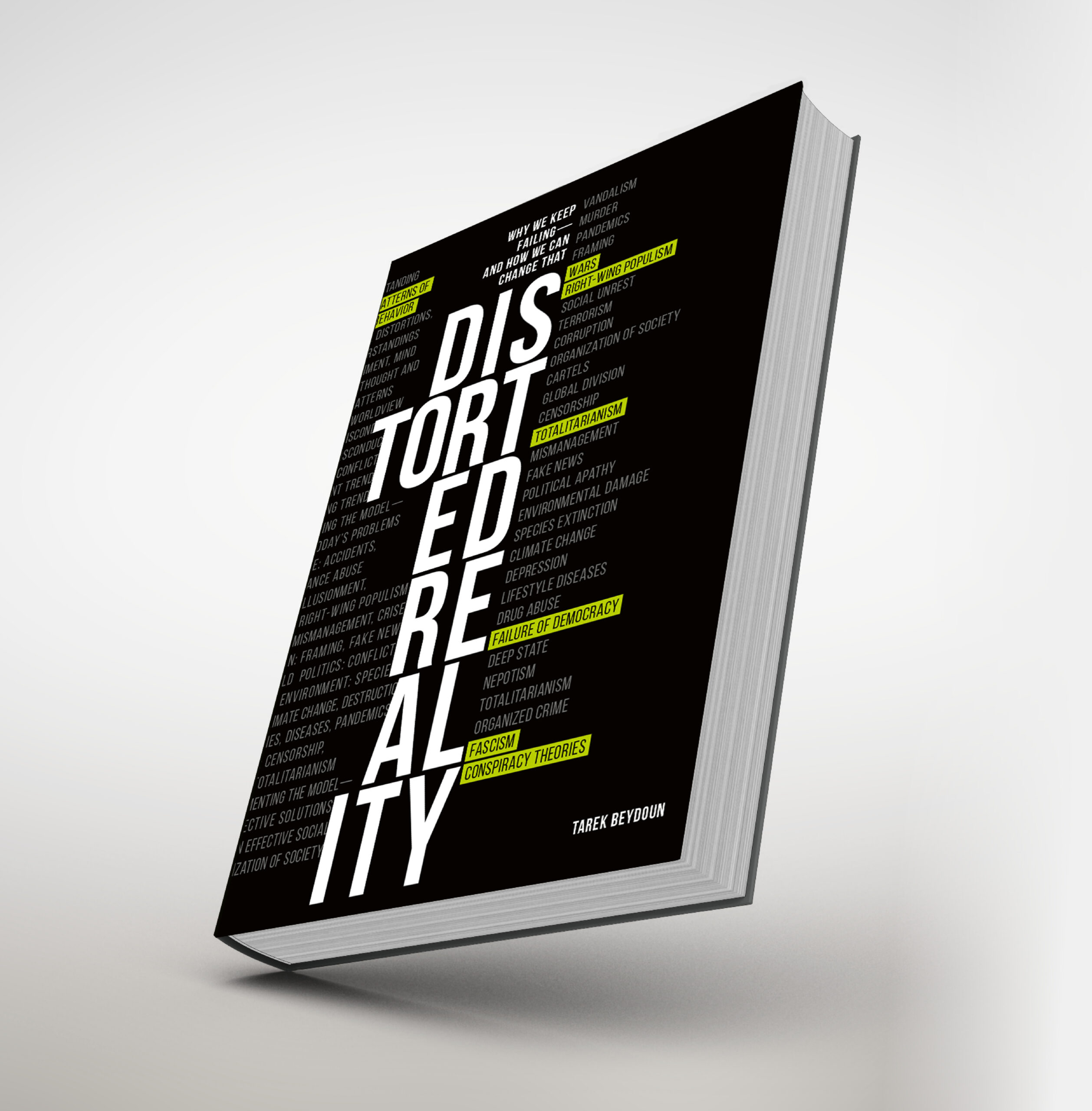
The operating system exists. It can be understood—and changed. Distorted Reality explains the mechanisms and derives concrete solutions.
-> Order here