Why Europe needs a strategic shift now — before Europe itself becomes a party to the war.
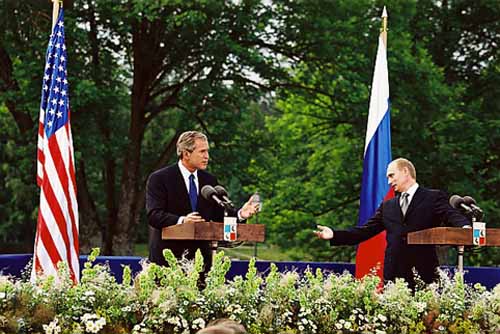
June 2001, Ljubljana, Slovenia. The first face-to-face meeting between George W. Bush and Vladimir Putin. NATO membership for Russia was on the table. Putin produced a recently declassified document from 1954 and read aloud what Bush apparently had not expected: in 1954, the Soviet Union had proposed joining NATO—a serious attempt to defuse the tensions of the nascent Cold War through integration rather than bloc formation. The West’s response was a rejection, packaged in four bureaucratic sub-clauses. The background: NATO had been founded as an alliance against the Soviet Union. Soviet membership would have stripped the alliance of its reason to exist.
That this logic had survived the end of the Cold War entirely intact was something Secretary of State Madeleine Albright had already made clear in 2000: when Putin publicly signaled openness to some form of NATO affiliation for Russia, she responded without consultation, without review, without process—it was not on the table. (National Security Archive, Dec. 2025; C-SPAN, 2001)
That is where this story actually begins. Not in 2022. Not in 2014. But in a pattern that repeats across decades: Russia asks, warns, and argues its case—the West stalls, deflects, and provokes.
Decades of Mounting Provocation
Anyone who wants to understand Russia’s military response in 2022 cannot treat it as an isolated act. It is the end product of a chain of individual steps—a security policy vice that closed over decades.
1990: There were assurances. They are documented. Foreign Minister Genscher declared on camera on February 2, 1990, alongside US Secretary of State Baker: NATO would not extend its defense perimeter eastward—and this applied „in general,“ not only to East Germany. Eight days later, Genscher confirmed the same to Soviet Foreign Minister Shevardnadze, recorded in a memo of the German Foreign Office. The West’s response to this day is a technicality: there was no signed treaty. True. But it raises a question that weighs more heavily: why did these two chief negotiators make this commitment at all? No one puts something meaningless on the table as a negotiating condition. Those who claim today that Russian security concerns about NATO expansion are a pretext must explain why the West itself offered them as a concession at the time.
It is also worth being clear about what NATO membership actually means in practice. It is not an abstract treaty. It means US troop deployments, US command structures, and US weapons systems. When Ukraine joins NATO, the United States stations troops and missiles on Russia’s border. That is not an interpretation—it is the operational reality of the alliance since 1949. (National Security Archive, 9.2.1990; German Foreign Office, Feb. 1990; Spiegel, Feb. 2022; SHAPE/EUCOM; Mearsheimer, 2014)
1999: The proof. NATO bombed Serbia without a UN mandate, outside its own alliance territory, without any member state having been attacked — the defining Article 5 trigger for collective defense simply did not apply. The alliance acted offensively, not defensively, in pursuit of American geopolitical interests. NATO is not a symmetrical defense alliance—it is a US-led instrument of American security policy, in which Washington makes the decisions, sets the structures, and defines the strategic priorities. (NATO, 1999; Mearsheimer, Europäisches Parlament, 18.11.2025)
1999, 2004, 2009, 2017, 2020: Five rounds of NATO eastward expansion, 12 nations—from Poland, the Czech Republic, and Hungary to the Baltic states and North Macedonia. The alliance’s border crept steadily toward Russia. Western military infrastructure followed. (NATO accession protocols, 1999/2004/2009/2017/2020)
2002, 2019, 2020: The United States unilaterally withdrew from three arms control treaties. In 2002, it withdrew from the ABM Treaty, which since 1972 had limited missile defense systems on both sides. Immediately afterward, the US began building missile defense systems in Poland and Romania—within range of Russian intercontinental missiles. In 2019, it withdrew from the INF Treaty, which had banned land-based nuclear intermediate-range missiles in Europe, in order to develop exactly those systems. In 2020, it withdrew from the Open Skies Treaty, which since 1992 had guaranteed mutual overflight rights for military verification. (NATO/Bucharest, 2008; US Department of State, 2002; 2019; 2020)
2010: The point at which NATO stopped being purely a defensive alliance was institutionalized in 2010—and sharpened further in 2022. At the 2010 Lisbon summit, energy security was officially declared an alliance task for the first time: NATO was to develop the capacity to protect critical energy infrastructure, transit areas, and routes—extending its remit, in effect, well beyond its own territory. The 2022 Strategic Concept reaffirmed this mandate: ensuring a stable and reliable energy supply has since been part of the alliance’s official core mission. This is not an accident of policy. It is strategy, written down. (NATO, 2010; NATO, 2022)
2014: In February, Yanukovych is ousted with US assistance, and a pro-Western government is installed. The Svoboda party—officially criticized by the European Parliament in 2012 for „racist, antisemitic, and xenophobic views,“ with the Waffen-SS symbol in its party logo—takes control of four ministries. Andriy Parubiy, co-founder of Svoboda’s predecessor party, takes over the National Security Council; Dmytro Yarosh, leader of Right Sector, becomes his deputy. At the same time, the Azov Battalion—with self-declared neo-Nazis in its ranks—is founded and integrated into the Ukrainian National Guard. All of this explains Moscow’s warning about a „takeover by radical nationalist, Russia-hostile forces“—and all of it continues to be dismissed as a Russian propaganda fairy tale. (BBC/Guardian, 5.2.2014; Reuters, Feb. 2014; European Parliament, 2012)
2015: The Minsk agreements are meant to pacify the war in Donbas. In 2022, Merkel herself admitted, „Minsk served to buy Ukraine time—time it used to rearm.“ Putin reacted with public disappointment: he said he had trusted the German leadership. (Merkel/Zeit Online, Dec. 7, 2022; Tagesspiegel, Dec. 9, 2022)
From the coup onward, Ukraine functions increasingly as an instrument of Western geopolitical interests—completely so under Zelensky.
The true significance of NATO’s eastward expansion became clear once the arms control treaties that constrained both sides were dismantled: a landscape stripped of oversight and transparency, with US missile defense systems in Poland and Romania—and a publicly pledged NATO membership for Ukraine. For military planners in Moscow, this meant US infrastructure potentially within first-strike distance of Russian command centers, with no 20-minute warning window that intercontinental systems still allow. Under these conditions, a first strike would become incalculable—and the reliability of one’s own second-strike capability could no longer be assured. A strategic catastrophe. This is not rhetoric. It is the foundational logic of nuclear deterrence that has governed strategy since 1945. Systematically dismantling it forces a response.
Decades of Ignored Warnings
What the US National Security Archive transcripts declassified in 2025 show is not a single incident but a pattern: over two decades, Russia articulates—consistently, bilaterally, multilaterally, publicly, and in writing—the same position. A NATO without Russia is an alliance directed against Russia. NATO membership for Ukraine is a red line. (NATO, April 2008; National Security Archive, Dec. 2025)
2007, Munich Security Conference: Putin delivers the sharpest public warning to date before an international audience. (MSC, 10.2.2007)
2008, Sochi: Putin explicitly warns Bush against NATO membership for Ukraine — the same year NATO enshrines exactly this prospect in the Bucharest Declaration. (National Security Archive, Dec. 2025; NATO/Bucharest, April 2008)
2014, the Kremlin: Putin states publicly that the Crimea annexation is his answer to the NATO question—“Anyone who lets Ukraine into NATO will find NATO ships in Sevastopol.“ (Putin/Kremlin address, 18.3.2014)
2018, the Kremlin: When Ukraine enshrines NATO membership in its constitution, the Kremlin formally demands that Ukraine be permanently excluded from NATO. (Kremlin/Peskov, 2018; Reuters, 2018)
Every one of these warnings received the same response: none.
2021: Russia tables two complete draft treaties — not a threat, but a concrete negotiating offer. Categorically rejected. (Reuters, 17.12.2021; NATO/Stoltenberg, Jan. 2022)
February 2022, Moscow: Macron and Scholz travel to Moscow in succession—the leaders of Europe’s two largest powers—in a conflict that directly concerns Europe. Russia restates its conditions for de-escalation. Both reject them by invoking Ukraine’s right to self-determination. (Macron/Putin press conferences, Scholz/Putin press conferences, Feb. 2022)
The response: Russia invades weeks later.
A Matter of Perspective
Self-determination is not a principle—it is an argument the West deploys selectively. Cuba in 1962 is the direct mirror: missiles in the neighborhood, existential threat, immediate military response—no discussion of self-determination. The world stood on the edge of nuclear war. Since the Monroe Doctrine of 1823, the United States has claimed the right to define its sphere of influence in the Western Hemisphere and has enforced it by military means repeatedly. Those who argue otherwise for Ukraine are reasoning selectively — which is to say, politically. (Mearsheimer, 2014)
Those who charge Russia with imperial aggression should first look in the mirror. A superpower that has conducted over 250 military interventions since 1991, toppled dozens of governments—including democratically elected ones—and waged proxy wars on four continents has no moral standing to bring that charge. Lawrence Wilkerson, Chief of Staff to US Secretary of State Colin Powell from 2002 to 2005, states it plainly: the United States lied about its wars and has done more than any other country to arm and fuel the proliferation of terrorist groups worldwide. Europe, which backed and participated in that policy for decades, has no more. This is not relativization. It is an observation: outrage is equally selective — and therefore political. (Wilkerson, PBS Frontline; „No End in Sight“, Ferguson, 2007; Congressional Research Service, R42738, 2023; Blum, 2003)
What history more clearly suggests is this: Putin did not ask for NATO membership out of sudden goodwill. It was a strategic calculation. Russia had lost the Cold War; the 1990s left behind economic devastation, oligarchic plunder, and the Chechen war. Integration meant Western capital, stability, and market access—a chance, a strategy, a way out. The frequently cited essay „On the Historical Unity of Russians and Ukrainians“—published in July 2021—is regularly cited as evidence of Putin’s imperial intentions. The timing of its publication tells a different story: Putin had concluded that the West could not be brought around through yet another diplomatic offensive. But his own population needed to be prepared for what he considered inevitable—an approaching confrontation.
Russia in 2022 did not set out to conquer but to restore. The condition Moscow sought had existed until 2014: a Ukraine outside NATO, governed by a leadership that did not ignore Russian security interests—the same model that exists in Belarus to this day. It was not Russia that changed the existing order. It was the West.
Who Benefits From This War
Three counterfactual tests define the frame: without NATO expansion, no war. With acceptance of Russia’s security proposals of December 2021, there is no war. With the Istanbul settlement of March 2022, the war ends after one month. Instead, Western intervention prevented exactly these outcomes.
Jeffrey Sachs, who testified before the UN Security Council, sums up the causal chain himself: the loss of Ukrainian territory would have been entirely avoidable—had it not been for the violent coup that toppled Yanukovych and installed a US-backed government fixated on NATO membership. Even as late as April 2022, the Istanbul process could have ended the war—the US blocked the settlement. (Sachs, UN Security Council, Nov. 20, 2023; Consortium News, March 2025)
The decisive question is not whether the war was planned but whether it was factored in as a possible consequence of a deliberately chosen strategy. US strategists are not amateurs. Brzezinski had already spelled it out openly in 1997 in The Grand Chessboard: a Ukraine separated from Russia and integrated into the West was the central geopolitical objective of American Eurasian strategy. NATO expansion, the rejection of Russian security proposals, the support for regime change in 2014—these are steps in a consistent strategy whose potential for escalation must have been war-gamed in every serious policy paper. (Brzezinski, The Grand Chessboard, 1997)
So who had an interest in a war? The answer is publicly documented. Senator McConnell repeatedly justified Ukraine aid by pointing out that nearly 70 billion dollars had flowed directly to American defense manufacturers—jobs in 38 states—without a single American life at risk. Senator Graham declared in Kyiv in May 2023 that it was „the best money we’ve ever spent.“ A former CIA Director and Secretary of Defense described the conflict as a proxy war and named the lever: Russian casualties. These statements do not prove a conspiracy. They establish something more sober: the war was in the interests of key actors—negotiated solutions were not. (McConnell/US Senate, 2023; Graham/AP, May 2023; Panetta/Bloomberg, March 2022)
In Europe, the same logic applies. The Rheinmetall share price rose at its peak by nearly 1,900 percent. The German defense budget recorded its steepest increase in decades. Defense was classified as „sustainable“ by the EU Commission following a lobbying campaign that began a full year before the invasion. No conspiracy here either—but a web of interests that makes de-escalation structurally less attractive than escalation. (Handelsblatt, 2025; LobbyControl/taz, 2024; EU Commission, 2021)
Europe as a Pawn
The irony is hard to overstate: the United States under Trump has by now abandoned the escalation logic it spent decades pursuing and is negotiating. Europe, meanwhile, remains locked inside it, driven by EU foreign policy chief Kaja Kallas and a coalition of Russia-hostile states—above all the Baltic republics and Poland—who have elevated their own historical experience with Russia into an all-European foreign policy. Twenty-one packages of sanctions have been imposed, while the United States relaxes its own sanctions as it sees fit. Macron wants to send troops. Britain is already supplying cruise missiles and planning their deployment. The Taurus manufacturer has been cooperating directly with the Ukrainian defense industry since June 2026. The result: Europe is now pursuing a confrontation and escalation policy that its original architect has long since abandoned. Europe is functioning as a pawn of competing interests—not as a player in its own right. (EU Council, 2026; US Treasury/OFAC, 2026; NBC News, 13.3.2026)
Meanwhile, the very threat used to justify this policy is being downplayed by the people best positioned to judge it. General Alexus Grynkewich, NATO’s top commander in Europe, stated publicly in June 2026 that Russia is not seeking direct military confrontation with NATO—Moscow, he said, is well aware of the alliance’s military superiority and the risks of attacking NATO territory. Erich Vad, military-political advisor to Angela Merkel from 2006 to 2013 and secretary of Germany’s Federal Security Council, has held this position consistently for years—and been just as consistently ignored. Already in 2024, he considered a Russian attack on NATO unlikely: Russian forces, he argued, were already too weak to occupy the whole of Ukraine, let alone risk a war with NATO. Moscow’s actual war aim, he said, was different—preventing Ukraine’s NATO membership and the stationing of Western troops there. Two years on, his assessment hasn’t changed—only the tone has sharpened: Germany, he warns, is sleepwalking into a pointless war, and sending German troops would be „highly immoral.“ Should the conflict escalate into a broader war, he warns, Germany—as NATO’s staging ground—would come „under fire across the board,“ leaving „not one stone standing on another.“ (Grynkewich, ILA Berlin Air Show, June 11, 2026; Vad, Weltwoche, Feb. 2026; Berliner Zeitung, 2024)
Two examples are enough:
Germany loses Nord Stream in an attack that the Federal Prosecutor General on July 1, 2026 charged for the first time as a war crime—committed by a Ukrainian military officer acting on behalf of Ukrainian state authorities. The German government stays silent. The billions keep flowing regardless of how the money is actually being spent and despite documented corruption scandals. (Federal Prosecutor General/ARD/SZ/Zeit, July 1, 2026; Federal Prosecutor General, Aug. 21, 2025; Tagesspiegel, Aug. 27, 2025; Transparency International, 2024; NABU, 2025; Economist, Nov. 2025)
Poland’s government stated officially that it was in its „vital interest“ that the suspected saboteurs face no prosecution—Prime Minister Tusk refused extradition. Poland had opposed the pipeline from the outset. Even Biden had announced its destruction weeks before the invasion: „If Russia invades, there will no longer be a Nord Stream 2. We will bring an end to it. I promise you, we will be able to do that.“ (taz, Oct. 2025; Tagesspiegel, 2023; White House Archive, 7.2.2022)
The consequences of European dependency: after Nord Stream was taken offline, Europe switched to American fracking gas at significantly higher prices. The same United States that demanded Europe sanction Russian oil continues importing it through third countries—while selling its expensive gas to Europe. In the wake of the Iran conflict, prices rose to 70 percent above pre-crisis levels. IEA Director Fatih Birol described it as „the greatest energy crisis in history.“ (Euronews, 27.3.2026; IEA, 2026; NZZ, April 2026)
None of the people cited here are outsiders. They are established figures with secure pensions or active academic careers who have far more to lose than to gain by breaking from consensus—a University of Chicago professor of international renown, a serving NATO Supreme Allied Commander, a former chairman of the NATO Military Committee, a former chief of staff to a US Secretary of State, a former advisor to Angela Merkel, and a sitting UN economic advisor. None of them need these statements for attention or income. That they arrive, independently of one another, at the same conclusion is not a coincidence. It is a finding.
The Strategic Shift Europe Needs
Instead of drawing lessons from its own share of responsibility for the escalation, Europe is repeating exactly the pattern that produced it: maximum pressure with no offer to negotiate, symbolic politics without strategy, mimicking the US line without any independent analysis of its own interests.
A strategic shift would mean treating diplomacy not as weakness but as the one option that in this entire history was never seriously tried. Articulating Europe’s own interests, rather than sleepwalking along an escalation logic that serves someone else. Separating energy policy from symbolic politics before the next crisis hits European industry and European households. And acknowledging that a continent that categorically rules out negotiated solutions does not escalate itself into a stronger position—it escalates itself into the next confrontation it can no longer control.“
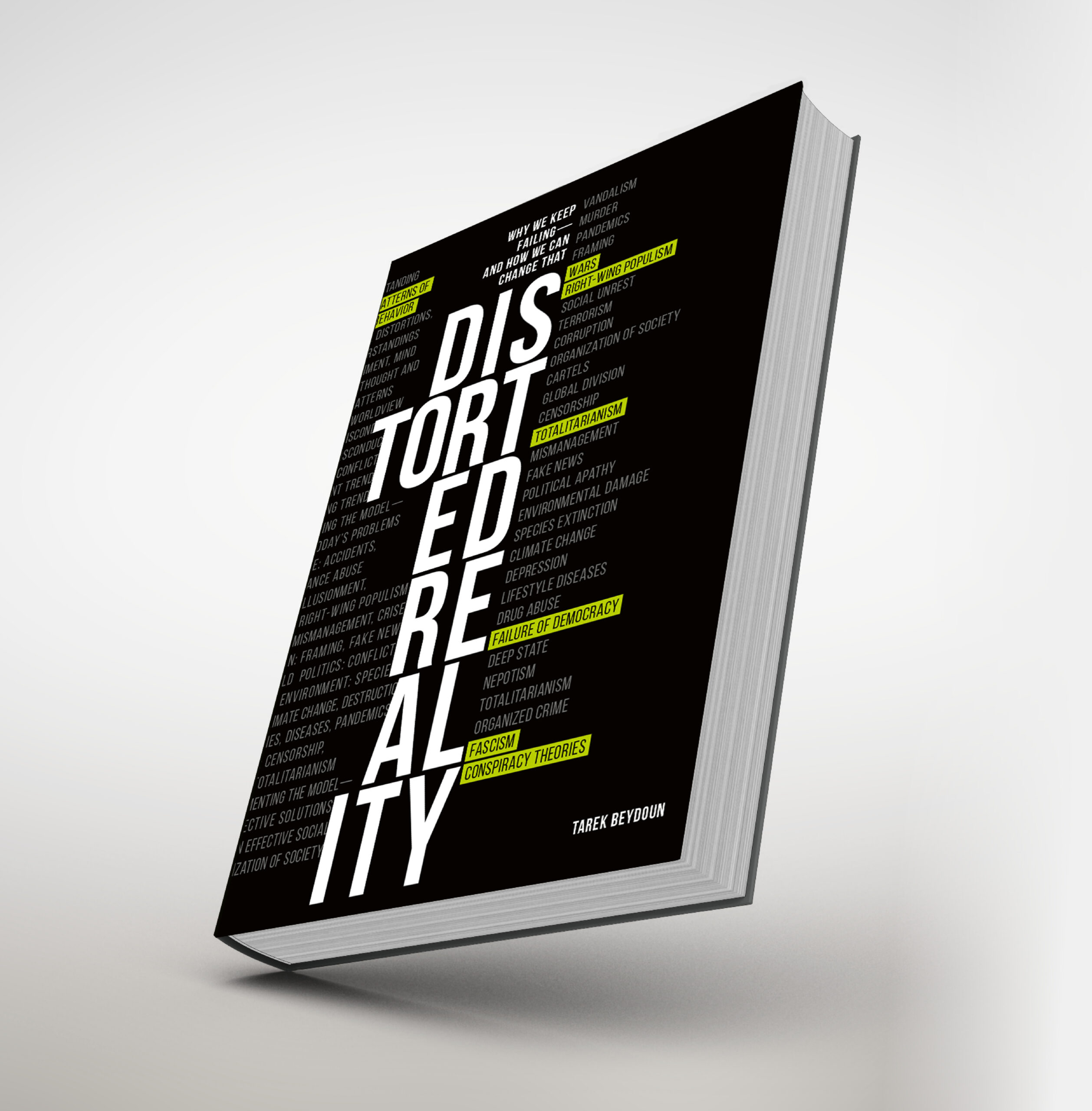
The mechanisms behind selective perception, interest-driven politics, and collective distortion of reality are explained in Distorted Reality -> Order here